
Notice of Deprecation: TM Removal of Alert Metadata Configuration

Change Target Date: May 31st, 2026

Fenergo will be removing the Alert Metadata Configuration section within the Reference Data domain. Due to low usage, this section is no longer required and will be retired at the end of May 2026.

What Does This Mean for You as a Fenergo User?

Once this change is in effect, the Alert Metadata Configuration section will no longer be available within the Reference Data domain.

Why Are We Making This Change?

This section has seen low usage across the platform and is no longer considered necessary. Removing it allows Fenergo to streamline the Reference Data domain and reduce unnecessary complexity for users.

Need Help or Have Questions?

If you have any questions or require support with this transition, please contact your Fenergo Client Partner, who will be happy to assist you.
Notice of Deprecation: TM Removal of Alerted Transactions

Change Target Date: May 31st, 2026

Fenergo will be removing the Alerted Transaction tab in the Alerts Dashboard. An extension of the information available here will be available in Advanced reporting so this tab is no longer useful. Furthermore, removing this information from the Alerts page will enhance the performance of the page. All transaction are available from the Entity profile transaction tab.

What Does This Mean for You as a Fenergo User?

Once this change is in effect, the Alerted Transactions tab will no longer be available in the Alerts dashboard. Alerted transaction information is available in Advanced Reporting.

Why Are We Making This Change?

There are multiple reasons for this change, firstly the need for this tab has been mitigated by adding Alerted Transactions to Advanced Reporting, secondly removing this information will have a positive impact on the performance of the Alert Dashboard.

Need Help or Have Questions?

If you have any questions or require support with this transition, please contact your Fenergo Client Partner, who will be happy to assist you.

Notice of Change: Limiting In-Progress Journeys Per Entity

Change Notice Date: April 27th, 2026

Planned Target Date: June 4th, 2026

Fenergo will be introducing limits on the number of journeys that can be in progress simultaneously for a single entity. This change is designed to protect platform performance and prevent unintended automation from generating excessive workload.

What Does This Mean for You as a Fenergo User?

Once this change is in effect, the following limits will apply per entity:

  • A maximum of 1,000 total in-progress journeys per entity.
  • A maximum of 500 in-progress journeys of the same journey type per entity.

If either limit is reached, the system will reject new journey creation requests with a 400 Bad Request API response. A validation error will be returned within Fenergo indicating whether the total limit or the per-journey-type limit has been exceeded.

If you encounter one of these errors, review and resolve existing in-progress journeys for the affected entity before attempting to create new ones.

Why Are We Making This Change?

This change has been introduced to maintain system stability and mitigate the risk of uncontrolled journey creation caused by configuration or process issues. By capping the number of in-progress journeys per entity, Fenergo can ensure consistent platform performance across all clients and reduce the impact of accidental or automated over-creation of journeys.

Need Help or Have Questions?

If you have any questions or require support with this transition, please contact your Fenergo Client Partner, who will be happy to assist you.

Notice of Change: Rollback Documents as a Data Source in Policy

Change Notice Date: April 2nd, 2026

The recently released Document Metadata Policy Trigger Condition feature has been removed from the platform. Following release, we identified an issue that affects environments with high volumes of documents, and in order to protect the platform stability for all clients we have made the decision to remove this feature at this time while we work on a more robust solution. If you have already begun configuring this feature, please reach out to your Fenergo representitive who will be happy to advise on alternative approaches in the interim. We apologise for any disruption this may cause.

Notice of Change: Significance Task Types New Permission

Change Notice Date: March 19th, 2026

Change Target Date: End of April, 2026

Fenergo will be introducing an update to the permissions required to interact with and complete the Significance Engine Results and Significance Agent Results Task Types. This communication serves as notice before the change is rolled out to production environments.

The updated implementation will introduce a new dedicated permission, Significance Task Edit, which will be required to override Significance outcomes and complete the task.

What Does This Mean for You as a Fenergo User?

Once this change is enabled, users will require the Significance Task Edit permission in order to interact with and complete the Significance tasks.

For any tenants already using Significance Task Types, users who currently have Significance Rule Access will continue to be able to view, edit, and complete the task. This is to ensure continuity of access during the transition period.

Why Are We Making This Change?

Following the recent separation of configuration and operational permissions, we identified the need to introduce a dedicated task permission, allowing configurators to better control which users can overwrite outcomes within the task, without granting access to underlying configuration.

This approach mirrors what we already do in other areas of the application and maintains the separation between configurational and operational users while providing greater flexibility and control over task interaction.

Need Help or Have Questions?

If you have any questions or require support with this transition, please contact your Fenergo Client Partner, who will be happy to assist you.

Notice of Deprecation: Entity Profile Page V1

Deprecation Notice Date: February 20th, 2026 Change Target Date: August 31, 2026

Beginning August 31, 2026, the Entity Profile Page V1 will no longer be available. Users will access and manage entity information exclusively through the Entity Profile Page V2 interface. This means the option to switch to or navigate to the Entity Profile Page V1 will be removed and Entity Profile Page V2 will become the only supported experience on this screen across all tenants.

What Does This Mean for You as a Fenergo User?

From August 31st, 2026, users will no longer be able to navigate to the Entity Profile Page V1. All entity-related activities on this screen will be performed exclusively within the Entity Profile Page V2 interface. There are no permission changes associated with this update, and no action is required in advance of the removal date.

Why Are We Making This Change?

Entity Profile Page V2 represents the strategic direction of the platform and provides a more modern and consistent user experience. Retiring the legacy Entity Profile Page V1 removes duplication in the interface and allows ongoing enhancements to be focused on a single, unified experience for the user.

Need Help or Have Questions?

If you have any questions or require support with this transition, please contact your Fenergo Client Partner, who will be happy to assist you.

Notice of Change: Improved user interface of the eSignature task

Change Notice Date: January 12th, 2026

Planned Target Date: End of February, 2026

Fenergo will be making changes to the user interface of the eSignature task. These changes will enhance the user experience of the task.

What Does This Mean for You as a Fenergo User?

Once this change is enabled, users will see the new and improved user interface of the eSignature task. The functionality of the task will remain the same.

eSig Image

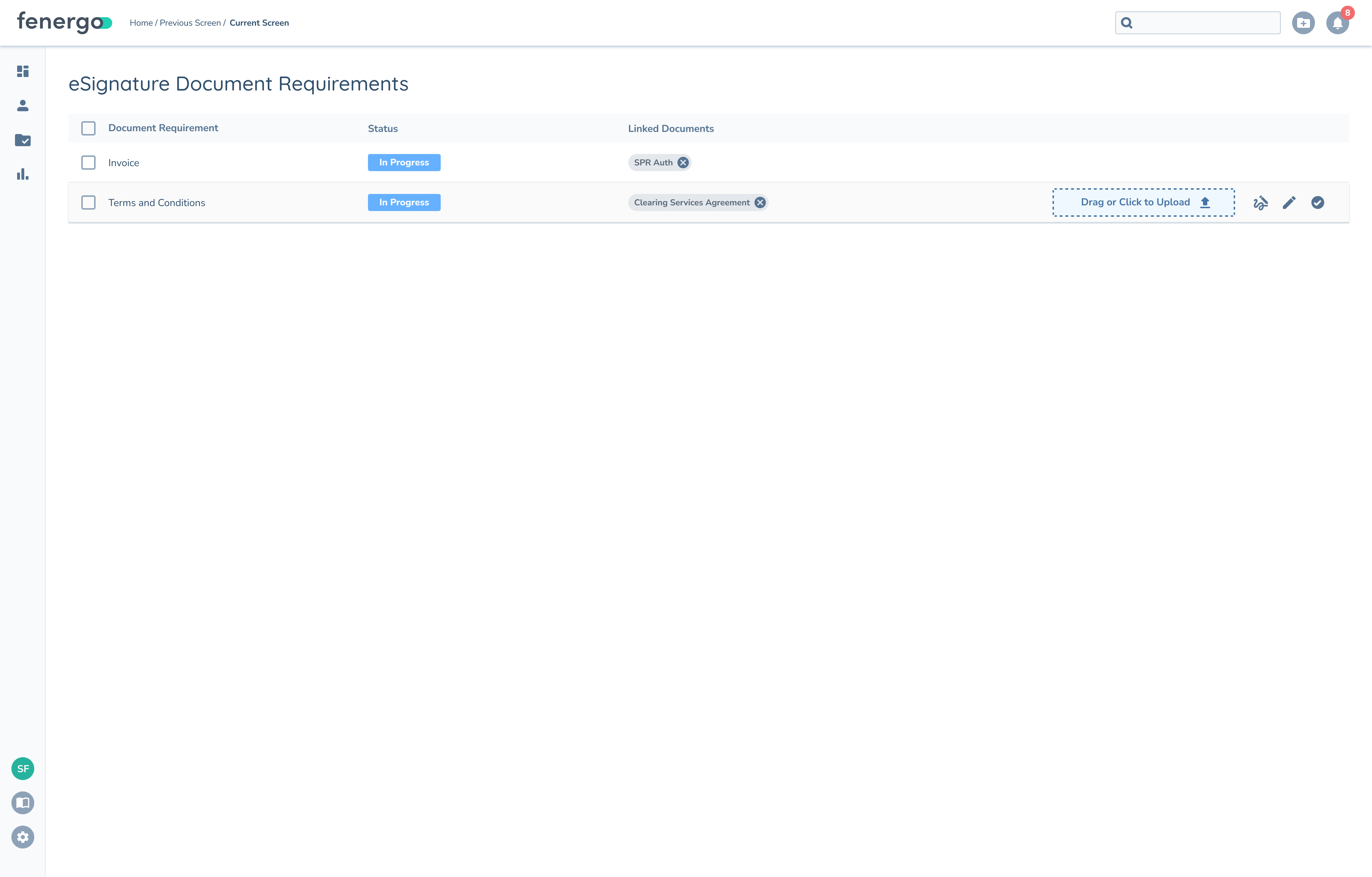
The new and improved UI of the eSig task includes:

  • Adjustment of the margin around the eSignature Document Requirement grid.
  • Wrapping of the 'status chip'.
  • New 'Drag or Click to Upload' component.

eSig Image

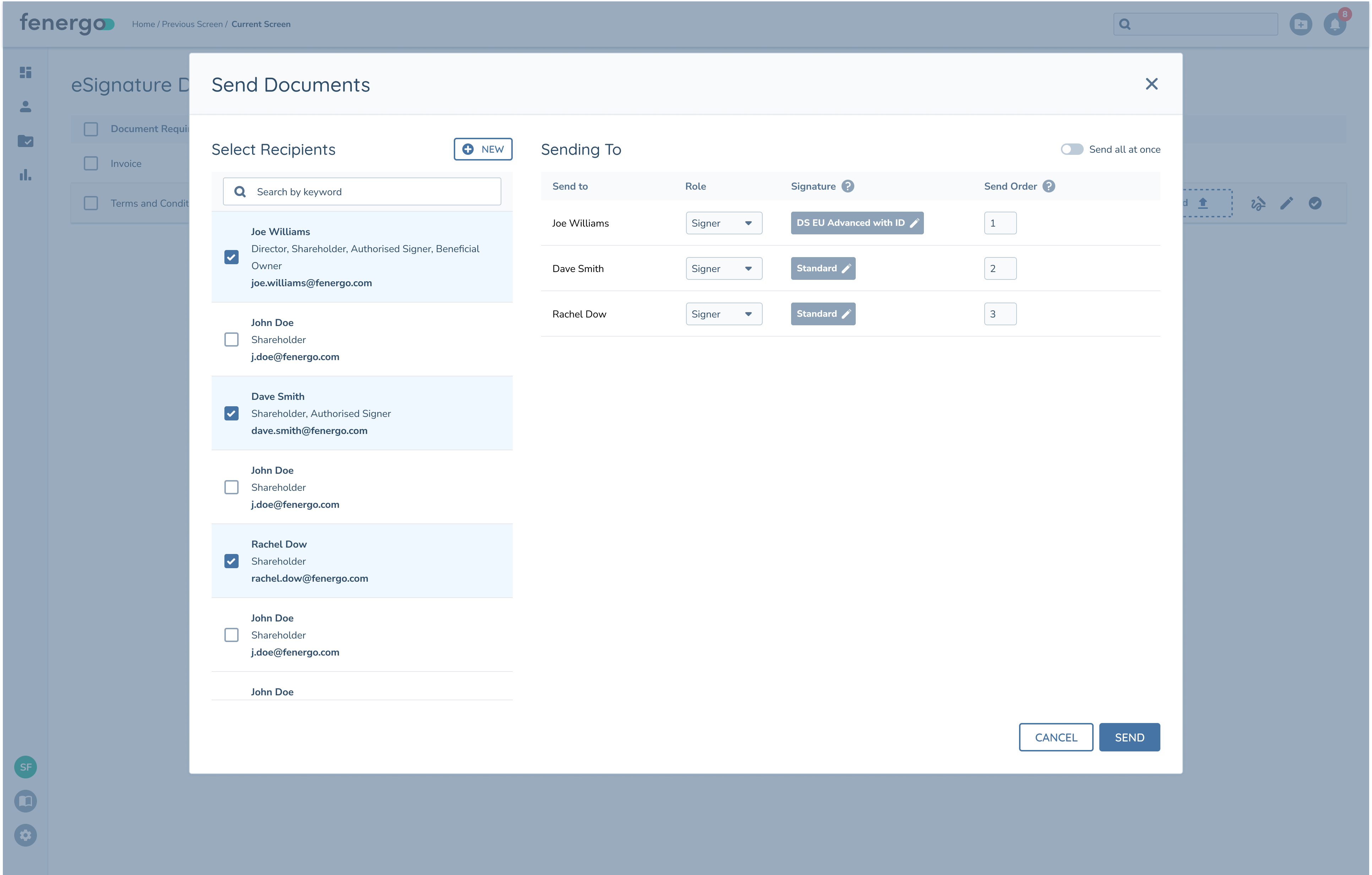
The new and improved UI of the Send Documents modal in the eSig task includes:

  • Highlighting the selected recipients.
  • Adjusments to font, size and style of text.
  • Wrapping of the 'signature type' chip.
  • Recipients will appear in a list rather than a grid.

Why Are We Making This Change?

To ensure a consistent and quality user experience, we are aligning the user interface of the eSignature task with designs created and approved by our user experience team.

Need Help or Have Questions?

If you have any questions or require support with this transition, please contact your Fenergo Client Partner, who will be happy to assist you.

Notice of Change: Significance Task Types Permission Change

Change Notice Date: December 22nd, 2025

Change Target Date: April, 2026

Fenergo will be making a change with regards to the requisite permissions needed to access the Significance Engine Results or Significance Agent Results Task Types. This communication serves as notice before the change is rolled out to production environments.

The current implementation ties the access and interactivity of the task with the same permissions required to configure the Significance Rules. This means that the operational users can also see the configuration.

The new implementation will remove any dependency on Significance Rule Access or Significance Rule Edit for task-level access and interactivity.

What Does This Mean for You as a Fenergo User?

Once this change is enabled, users will be no longer require the Configuration Permissions in order to interact with the Significance task.

For any tenants already using Significance Task Types, the existing permission sets will apply until April 2026.

Why Are We Making This Change?

Based on speaking to our clients, we want to be able to provide users with the ability to use the Significance task types without having the ability to view, edit or delete the underlying configuration. This approach mirrors what we already do in other areas of the application. For example, users may interact with policy via a data capture task but may not view the underlying policy configuration. By separating these permissions, we allow for greater separation between configurational and operational users.

Need Help or Have Questions?

If you have any questions or require support with this transition, please contact your Fenergo Client Partner, who will be happy to assist you.

Notice of Change: Related Party Access Layer Inheritance

Change Notice Date: December 17th, 2025

Change Target Date: January, 2026

Fenergo will be making a change to implementation of Related Party Access Layer Inheritance. This communication serves as notice before the change is rolled out to production environments.

The current implementation allows for separate inheritance changes to be created per journey and restricts access to related party entities by extending the access layers of the root entity to all levels of its association hierarchy within the journey.

The new implementation will evaluate and pass down access layers using the overall association hierarchy instead of using the journey context. There is also a change where only Client entities or Offboarded Client entities will be the root for inheritance.

What Does This Mean for You as a Fenergo User?

Once this change is enabled, any tenant that enables Related Party Access Layer Inheritance from that point on will utilise the new implementation for inheritance.

For any tenants where the current Related Party Access Layer Inheritance implementation is in use, once agreed, a migration will be performed to transition the inheritance to the new format.

Why Are We Making This Change?

The existing implementation has created growing complexity which can cause overload in tasks that process hierarchies due to the inheritance processing. The new implementation introduces a much simpler inheritance logic that is easier to understand and reduces the amount of processing required. This lower processing complexity will mean faster evaluation for large hierarchies, and the simpler inheritance logic will be easier to maintain and scale.

Need Help or Have Questions?

If you have any questions or require support with this transition, please contact your Fenergo Client Partner, who will be happy to assist you.

Notice of Deprecation: Introduction of Dedicated Data Groups Management Area

Deprecation Notice Date: December 11th, 2025 Change Target Date: January, 2026

Beginning in January 2026, Data Groups will be managed in a new, dedicated Data Groups section within the Policy domain of the Management menu. This means Data Groups will no longer be accessed from within the Policy configuration screen, but instead from their own centralised management area.

What Does This Mean for You as a Fenergo User?

You will now navigate to Management → Policy → Data Groups to view, create, and maintain Data Groups. All existing Data Groups will appear in a familiar grid format, exactly as before. No functional changes are being introduced. There are no permission changes associated with this update.

In short: this is a navigation and usability improvement, not a feature deprecation or behavioural change.

Why Are We Making This Change?

This enhancement provides a centralised, dedicated management space for Data Groups, improving clarity, usability, and overall configuration workflow efficiency. By separating Data Groups from the broader Policy configuration screen, we ensure a cleaner structure within the Policy domain and make configuration tasks easier for Fenergo configurators to manage and maintain.

Need Help or Have Questions?

If you have any questions or require support with this transition, please contact your Fenergo Client Partner, who will be happy to assist you.