Credit Assessment
Credit assessment is an important step in the credit origination process where the lender evaluates the creditworthiness of the borrower and decides whether to proceed with approving the credit product.
Automated Credit Assessment
The Automated Credit Assessment task sends request automatically to external decisioning providers for credit assessments.
Journey Task: Automated Credit Assessment
A user can navigate into the “Automated Credit Assessment” task to view assessment outcomes returned from external providers.
Credit Assessment Statuses
On the left-hand side, a vertical tab displays the entity being assessed and external providers that the assessment requests have been sent to. A status chip is placed next to the entity name to indicate the completion of credit assessment and against each individual assessment provider. There are three possible credit assessment statuses:
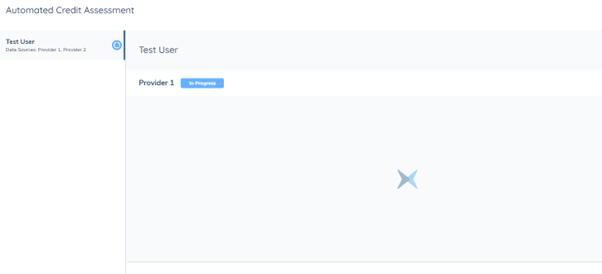
“In Progress”
At least one provider is still completing the credit assessment, therefore, the user will see a blue in progress icon next to the entity’s name for the overall status. Whilst the assessment is in progress, the user will need to refresh the screen to see any responses received. Notifications are being considered to notify the user when the request has been completed.
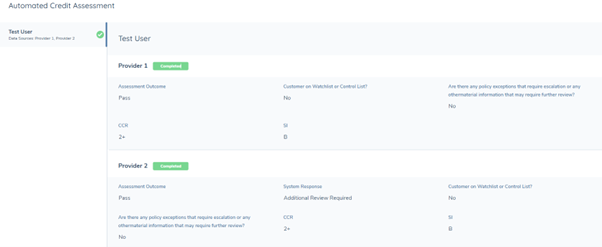
“Completed”
Credit assessment requests to all providers have been completed successfully, therefore, the user will see a green check next to the entity’s name and individual provider. The responses are configured through API integrations with each provider.
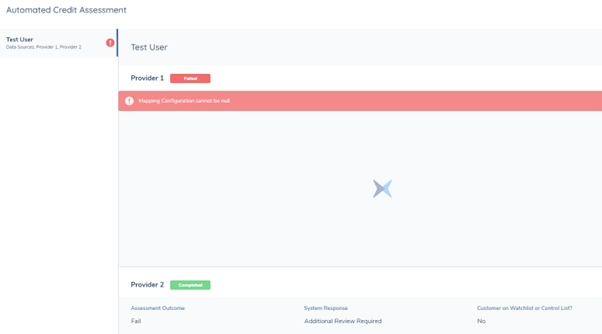
“Failed”
At least one request to a provider has failed, therefore the user will see a red warning icon next to the entity’s name for the overall status. When the assessment request has failed, no response can be received until the error is fixed, error messages are displayed in the section below each provider. When an error returns, there is an automatic retry mechanism that will make up to 3 attempts to retrieve Automated Credit Assessments. If the error persists after retries, then we will display the error messages in the section below each provider.
Troubleshooting
A failed credit assessment request is usually caused by misconfiguration, below are some examples:
- Adapter schema cannot be null
- Failed to map search criteria with mapping configuration
- Adapter schema response does not match mapping configuration result – missing search criteria
- Failed to validate search criteria with adapter schema
- Credit assessment enquiry has timed out and has been marked as failed. Note: A 30-minute time out period has been implemented. If no response received after 30mins, the task will be marked as completed so it will not block the user to complete following tasks We have outlined solutions for these common errors in our technical guide, and the user can follow the instructions to fix the configuration.
Credit Assessment Task Conditions
Journey Builder has been extended to include Manual Credit Assessment as a Source. Assignment and scoping conditions for a Stage, Process and Task can now be triggered using manual credit assessment data alongside the existing data sources.
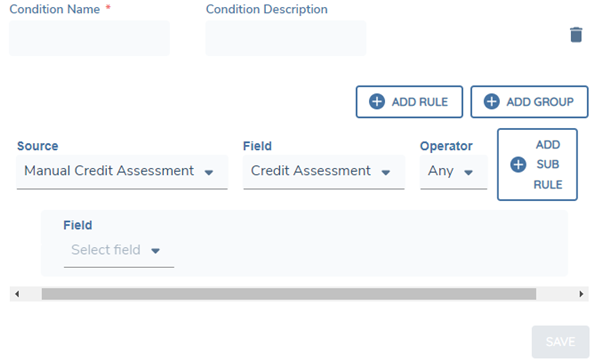
A new ‘Source’ value of ‘Manual Credit Assessment’ has been introduced to the Stage, Process, Task and Task Assignment Scoping Conditions within the Journey Builder. When this ‘Manual Credit Assessment’ value is selected from Source, and ‘Credit Assessment’ from the associated Field dropdown, the Operator option will be available for selection. The additional Field option in the condition will present the user with fields and data groups configured in the latest published versions of Policy. The source of “Manual Credit Assessment” can be used to assign or trigger any task types in the journey.
There are three options dedicated for the source ‘Manual Credit Assessment’:
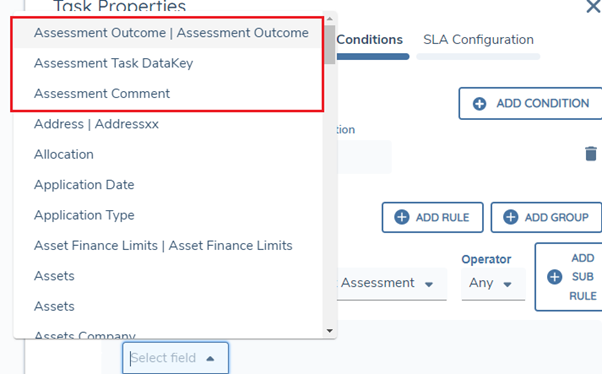
‘Assessment Outcome’ This option is specifically designed for the field with datakey “assessmentOutcome”. User can utilise the assessment outcome data to conditionally trigger rules.
‘Assessment Task DataKey’
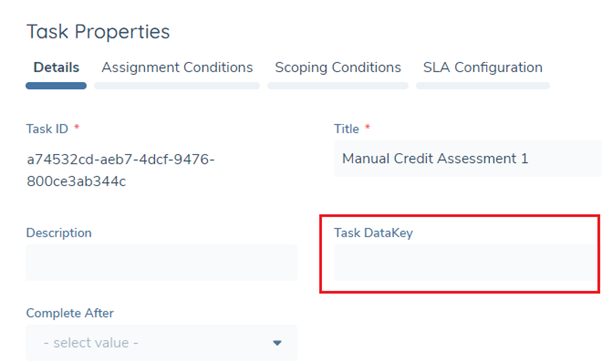
Task DataKey is an optional field under the Details tab, and each task can have one Task DataKey.
User can specify the fields in the task with Assessment Task DataKey selected to be used to conditionally trigger rules. If a task datakey is entered, then the trigger condition will check the field value in the specific task.
Journey Task: Manual Credit Assessment
Given the same category has been selected for the Manual Credit Assessment task, when the user navigates into the task, then they will see the data requirements with the same category appear in the task. The data requirement should have same conditional logic and validations as how it’s configured in Policy.
Credit Application Details
Users have the visibility to main entity and credit application details before making the credit assessments.
Access Entity Profile Page
The main entity name is displayed above the tabs with a clickable hyperlink. This will allow users to view the entity profile page of the main entity in a separate tab.

View Credit Application Details
There is a dedicated field “Details Tab- Policy Category” in the Journey Builder for user to select what details are required for decision making.
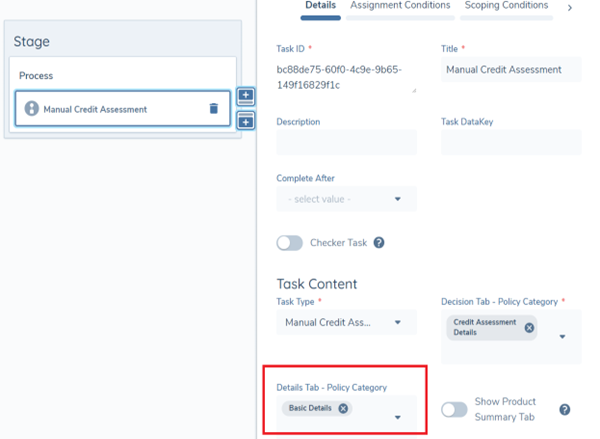
Once policy categories are selected for the Details Tab, then the in-scope data requirements persisted from previous Entity Data tasks will be displayed under the Details tab in a read-only view. The value persisted from previous credit assessment tasks will be displayed under the Approval Flow tab.
Users will not see the Details Tab in the Credit Assessment task if no policy category is selected or no in-scope data requirement.
Credit Assessment Approval Flow
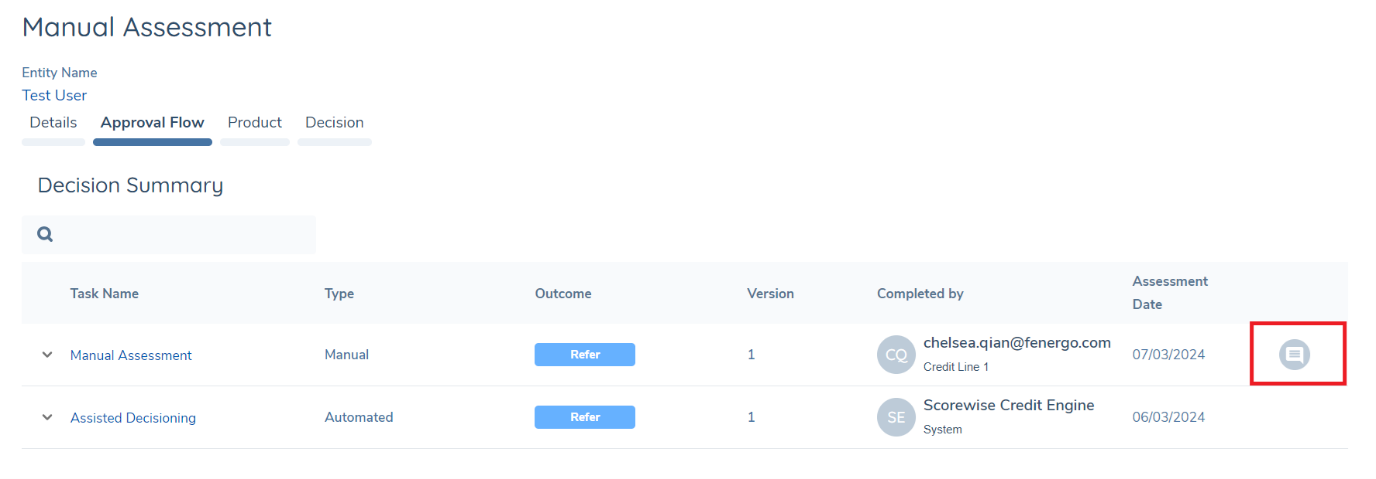
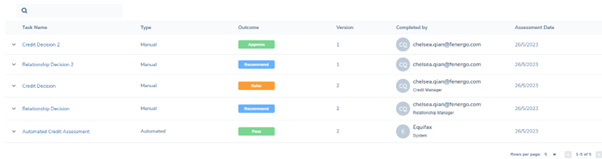
For the user to make credit assessment with reference to the historical decision, we capture all assessment outcomes completed within a single journey under the Approval Flow tab. The user can view previous automated and manual assessments decision summary in the Approval Flow tab, including the approver’s team, the outcome of previous decision, status and date of assessment completion. The decision summary is displayed from the latest to earliest of the Assessment Date by default.
Automated Assessment Decision Summary
The automated assessment decision summary for the entity will be grouped by the assessment task and the provider. If there are multiple assessment providers in the same task, then the result will be shown as separate rows. If one task has sent requests to the same provider for multiple times, then user can view the previous version of assessment in the expandable area.

The user can also map a field in Automated Assessment Task to be displayed as the “Outcome” for each provider from the backend.
Manual Assessment Decision Summary
If the previous user entered value for the spotlighted field with datakey “assessmentOutcome”, then that value will be displayed in the Outcome column against the relevant task.
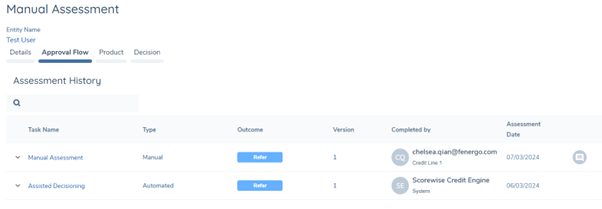
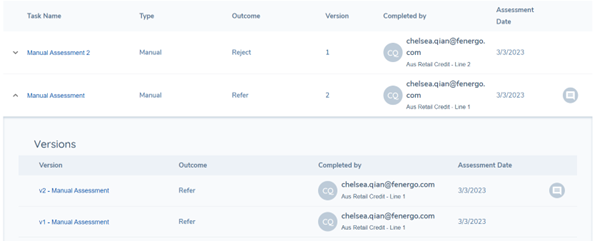
If a task has been reopened and completed for multiple times, the user can see all history versions of the task by clicking the arrow next to the Task Name.
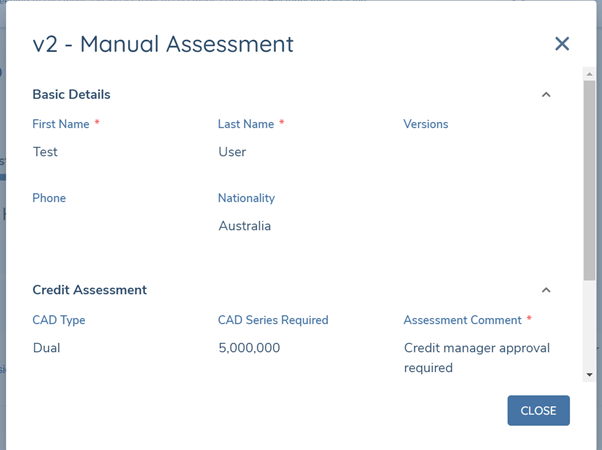
Once a user selects a version of a credit assessment task, they will see a modal with all fields in that task captured.
Credit Assessment Product Details
Users have the visibility on products associated with the entity before making the credit assessments.
View Product Summary Table
There is an option to view Product Summary Tab in the Manual Credit Assessment task. The user must select the Product Summary Category for the product summary view, and maximum 15 data requirements from selected categories will be shown. The category can either be an existing one from the product task within the same journey, or it can be a newly created category specifically for the product summary. Users must ensure that the datakeys within the category are present in the product task, so that any values entered can be captured and shown in the product summary.
The product summary grid won't show fields with trigger conditions or those created in a non-global policy. Additionally, it cannot support two fields with the same datakey within the selected category. The recommended configuration is to ensure that all fields have unique datakeys within a category created in global policy.
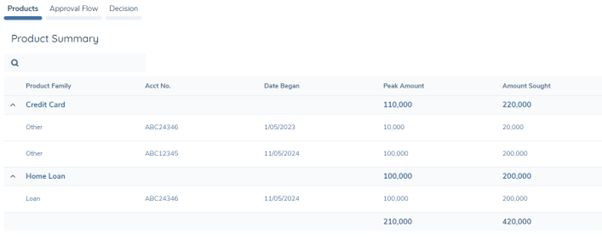
The data requirements will be sorted by the category order first, then the requirement order. The first requirement will be used to group the products in the product summary grid. If a product doesn’t have a value for the selected grouping requirement, it won't appear in the list.
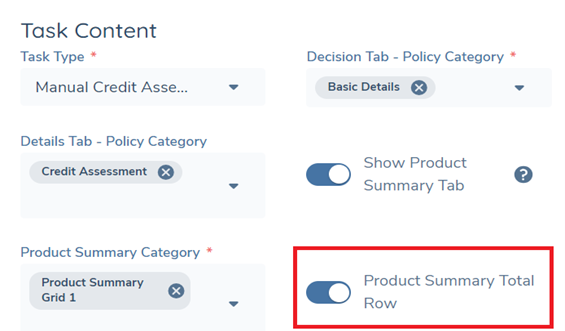
Users have the option to activate the Product Summary Total Row, which aggregates the value of each number or calculated field data requirements in scope in a total row. Note the first two columns of the grid don’t have the total at the bottom, so it’s suggested to set up the numeric field starting from the third column onward in the grid.
To view the Product Summary table in the Credit Assessment task, the user needs to make sure they have the Product Access & Search and Product Requirement Scope permissions. Given the user has enabled the Product Summary Tab for the task in the Journey Builder, the tab with the product summary table will be displayed for credit assessment purpose. The products will be grouped based on the first data requirements within the first category selected for the product summary table.
The Product tab shows all products onboarded in the current journey, and verified products in the other journeys.
Consideration
- Each credit assessment task is designed to capture a new credit assessment each time the task is created, the data between assessments is not shared. This is because each outcome is unique, and the data should not persist between decisions.
- Credit Assessment tasks currently only accept the field with trigger conditions or conditional value triggered by Current Entity Data Source in the Policy.
Configuring the Credit Assessment Feature
Credit Assessment Provider Configuration
The system supports the use of more than one Credit Assessment Provider, which allows users configure any Custom Providers for use from Credit Assessment Providers page.
 Enabling/Disabling more than one provider can be configured from the main Provider screen by toggling the Active toggle switch. This can also be done from inside any of the Providers Screens through the Active toggle switch.

Automated Credit Assessment Configuration
To enable automated credit assessment, you must create a “Automated Credit Assessment” task type in the journey builder.
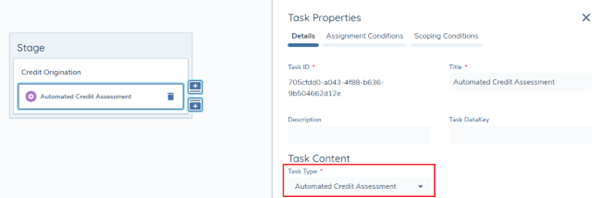
The “Automated Credit Assessment” task is an automated system task that orchestrates the credit assessment requests to the provider(s) integrated. There is no user action required to initiate and complete credit assessment. The credentials and provider-specific settings are defined via API integrations.
Where more than one provider is integrated, the assessment requests will be passed to each provider and returned asynchronously.
Manual Credit Assessment Configuration
Manual credit assessment allows the approver to manually capture a credit assessment outcome for an entity. To enable manual credit assessment, you must create a “Manual Credit Assessment” task type in the journey builder.
This task can be configured anywhere in a journey. Configurators can create the task multiple times in any single journey and use Assignment Conditions and Scoping Conditions to allow multiple teams to make credit assessments for a single application.
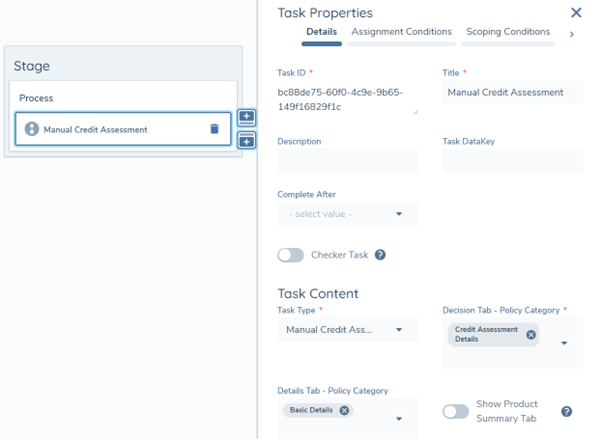
Policy Category in the Task Properties is used to connect the data requirements in Policy and Manual Credit Assessment task. The Policy Category selected here must be the same as the Requirement Category in Policy to enable the fields to appear in the Manual Credit Assessment task.
It’s mandatory to select a Policy Category for the Decision Tab, while it’s optional for Details Tab. If no Policy Category is selected for Details Tab, then the tab will be hidden in the credit assessment task.
If the data requirements for a manual credit assessment task are configured in a non-global policy, the data requirements in that jurisdiction will only be triggered if the current entity data meets the policy scoping conditions. If the data requirements within the policy have any trigger conditions, then they will only be triggered if the data in the current manual credit assessment task meets the conditions.
Multiple Assessments Configuration
In cases where multiple Manual Credit Assessment tasks have been created in a single journey, the tasks may show different data requirements under the Decision tab given different policy categories that are selected in the Task Properties. This allows approvers to complete the tasks assigned with specific data requirements based on their teams and roles.
In addition, the credit assessment data is not shared between tasks in the journey as each assessment is unique. The user will start from a new version of the credit assessment every time the task is initiated or reopened.
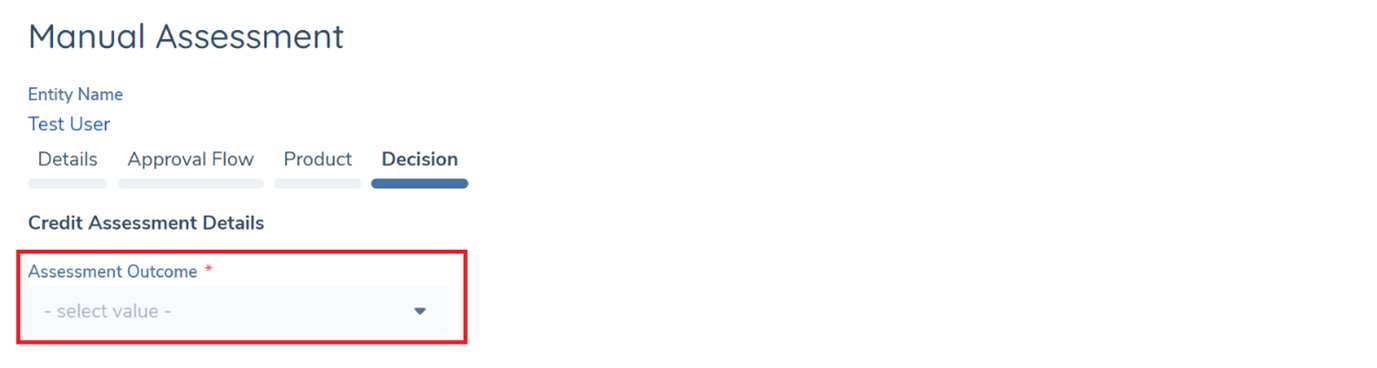
The user can spotlight a data field for credit assessment purposes via the Policy Configuration. To achieve that, the user needs to create a data requirement with the database field name “assessmentOutcome”. The datakey is case sensitive and needs to be an exact match so that this field can be spotlighted. This field can be configured as any field types with relevant validations.
Once the field has been configured in the Policy and the specific policy category is selected in the Journey Configuration, the user can see this field populated on top of other data fields. The value entered for this field is saved and displayed in the Credit Assessment Approval Flow tab for future reference. Every time the task is reopened, this field will be reset and the user will need to re-enter the value for the latest assessment outcome.
The user can also view the comments from previous assessment approvers in the Credit Assessment Approval Flow grid. To achieve that, the user needs to create a field with the database field name “assessmentComment” in the Policy, and value entered for this field will be displayed in the pop up comment box under the Approval View tab. The datakey is case sensitive and needs to be an exact and this field can be configured as any field types with relevant validations.
‘Assessment Comment’ This option is specifically designed for the field with datakey “assessmentComment”. User can utilise the assessment comment data to conditionally trigger rules.
Assessment Outcome Status Configuration
The outcome column in the decision summary grid can be configured as a status chip with a selection of colours. In the Reference Editor, a lookup list named as “Assessment Outcome Status” is required. On the first column “Reference Data”, the user can configure any possible manual and/or automated credit assessment outcome. Then, the second column can be used to map the outcomes to the status of the chip.
Four statuses of the chip are supported in Credit assessment task, and each of them is mapped to a specific colour:
- Success – Green
- Neutral – Blue
- Warning – Orange
- Alert – Red
By mapping the outcomes to the status, the user is also mapping the outcome to the colour implied. For example, if Fail is mapped to Alert, then it will be displayed in a red status chip in the Decision Summary grid.
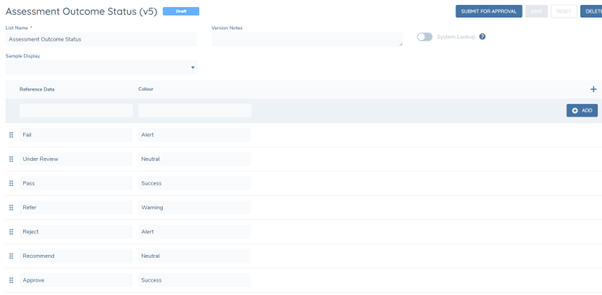
To automated credit assessment outcome in a status chip, the user will need to map one data field in the automated task to be displayed as the “Outcome” for Decision History Summary first. The values of this field also need to be mapped to the status in the Reference Editor.
Please note that the lookup list name “Assessment Outcome Status” is case sensitive, if this lookup cannot be found, then the outcome will only be displayed in plain text. The status entered in the second column must be the exact match of one of the four status, no white space allowed but case insensitive.