Ongoing Monitoring Data and Screening
Ongoing Monitoring: Data & Screening is Fenergo’s solution for continuous monitoring of entities for real-time changes from external sources. It currently supports ongoing monitoring of changes for both External Data and Screening through integration to third party providers. The purpose of this User Guide is to consolidate content from other domains into a single document.
Ongoing Data Monitoring
Ongoing Data Monitoring allows users to subscribe for updates to an entity record as part of External Data. When an update event is consumed from the External Data provider, a journey can automatically be triggered to process the event. Of the OOTB External Data integrations, Kompany is currently the only provider that supports Ongoing Monitoring.
Ongoing Monitoring - Subscribe
Users can subscribe to the Ongoing Monitoring of an entity by including the External Data Monitoring Subscription service task directly after the External Data Combined task in the Journey. Upon completion of the External Data Combined task, the External Data Monitoring Subscription task will run automatically, and will subscribe the entity for Ongoing Monitoring. The Update Categories that are available will be dependent on what the External Data provider supports. For kompany only Basic Details are supported currently.
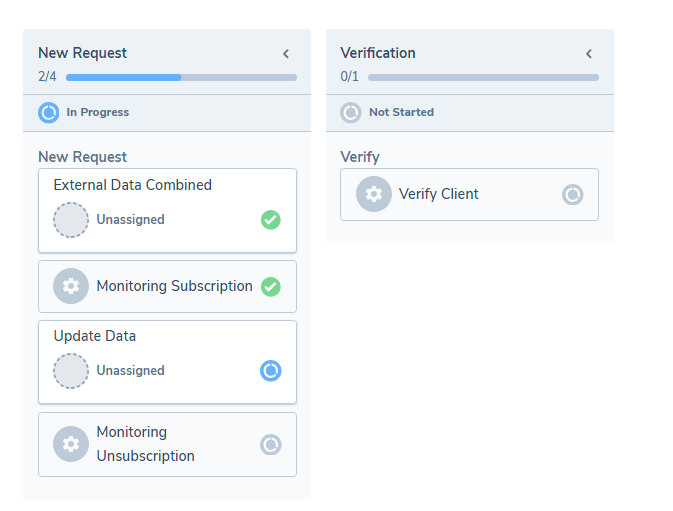
Once an entity is enabled for Ongoing Monitoring, the External Data provider will send an alert to Fenergo SaaS when there is an update to the entity data, which in turn can trigger an Ongoing Monitoring journey in Fenergo SaaS.
Ongoing Monitoring - Unsubscribe
To Unsubscribe from Ongoing Monitoring, the configuration user must configure the External Data Monitoring Unsubscription service task in the journey.
Journey Task: External Data Refresh
When on Ongoing Data Monitoring event is triggered from an External Data provider, often the provider will simply notify that something has changed but not provide the updated data as part of the event. This is an automated task that pulls a refreshed dataset from the External Data Provider in order to consume the updated data.
Note: For Kompany Ongoing Monitoring, this task must be included the first task of the Ongoing Data Monitoring journey.
Journey Task: Change Acceptance
The Change Acceptance task uses the existing Proposed Changes Task Type to present the user with a comparison screen that will allow them to easily see what data attribute has changed, and to compare the existing value to the new value.
The fields that have changed are displayed with an orange UI icon to alert a user that a decision may need to be made. Values that are identical, in both the previous and current data, are hidden by default. If there is no value entered in the field before, the field will not appear as there is no comparison to be made.
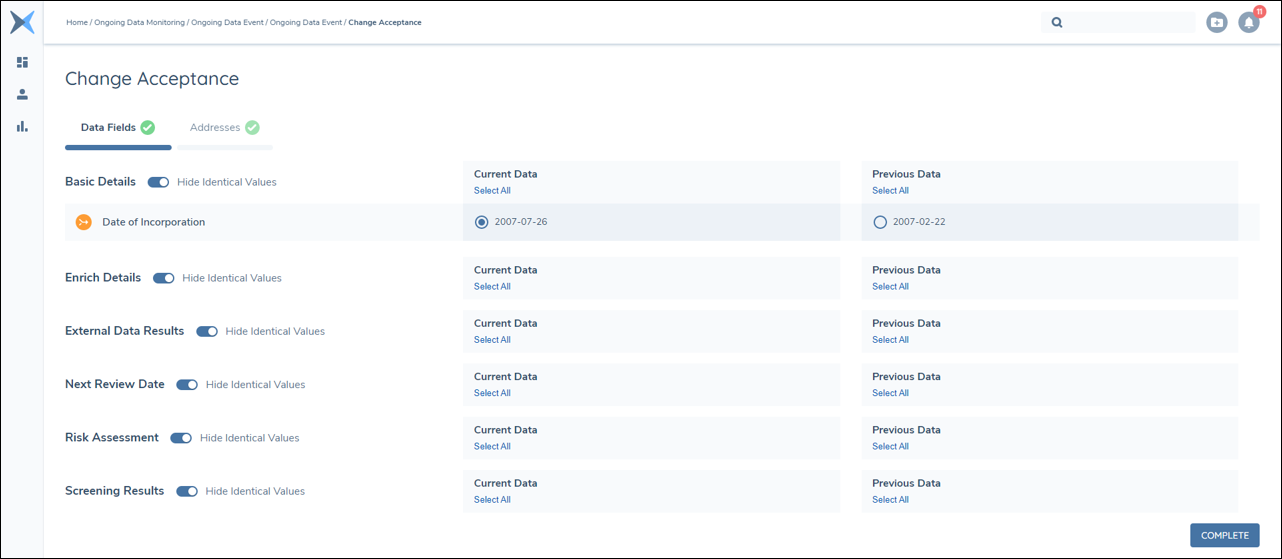
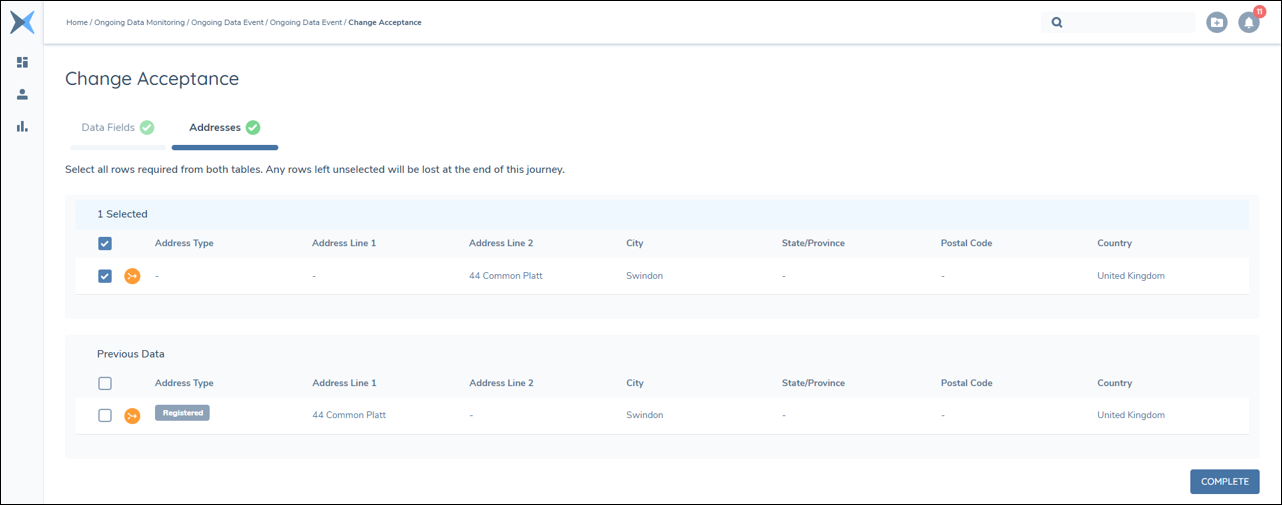
Data groups are broken down into two sections on screen, the current entity draft in the top section, and the verified data in the bottom. The user can pick any combination of these from across both sections to combine. This will form the new data group on the entity when the journey has been completed.
Journey Task: Recalculate Risk
It is recommended at this point to calculate an indicative Risk Assessment which will incorporate the updated entity data and reflect any potential impact that may have to the Risk Rating of the entity. The outcome of this indicative Risk Assessment can also be used as an input to the materiality rules that drive the rest of the journey.
For example, if the entity had a previous Risk Rating of Low and the Ongoing Data Monitoring update has resulted in the indicative Risk Assessment calculating as High, the fact that the Risk Rating has changed can be used as a Scoping Condition for any subsequent Stages/Processes/Tasks.
Ongoing Screening
Ongoing Screening involves the monitoring of an entity profile by a screening provider to capture any changes that may occur after the initial screening has been completed. Any new hits or changes to existing hits will result in a new Ongoing Screening journey being triggered in Fenergo SaaS for a user to action.
An Ongoing Screening journey must be configured in Fenergo SaaS to support Ongoing Screening, as well as any provider specific configuration as described in the Screening Configuration section. The following pre-configured tasks are available:
- OGS: Screening Match Resolution
- OGS: Confirmed Match Verification
- OGS: Materiality Assessment
- Close Screening Batch
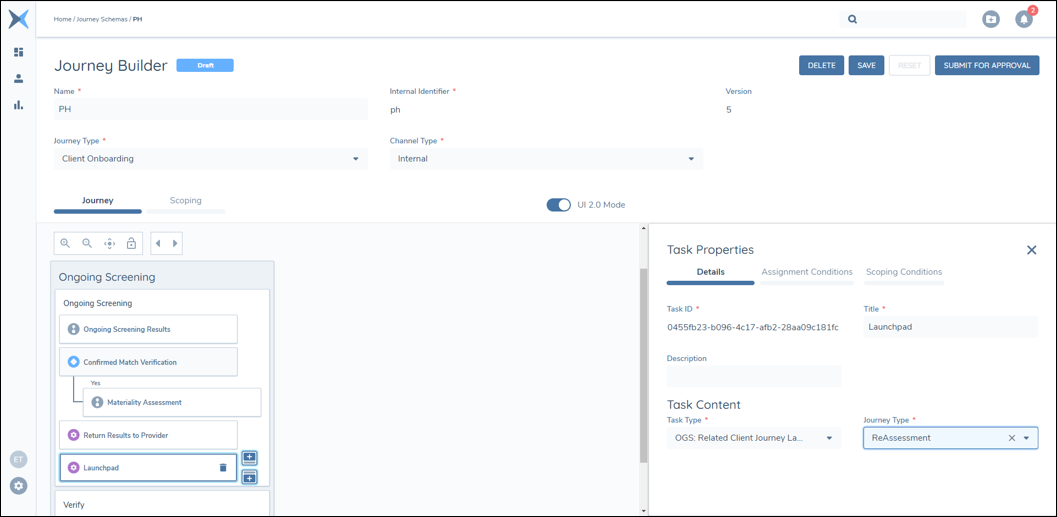
- OGS: Related Client Journey Launchpad
The suggested configuration of these tasks is as follows:
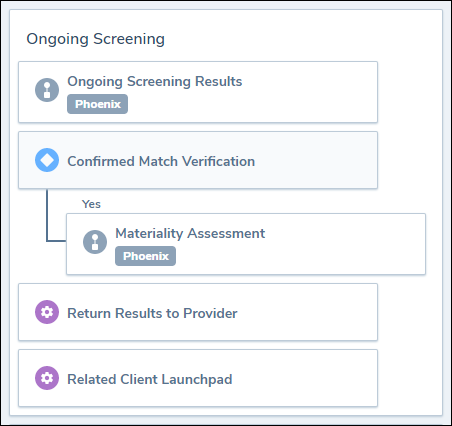
For more information, refer to Configuring Journeys.
Journey Task: Screening Match Resolution
This task presents the new results that have been triggered during the ongoing screening process and allows the user to determine whether the results are matches or false positives.
This follows the same patterns as match resolution for On Demand Screening. Please refer to Journey Task: Screening Match Resolution in the On Demand Screening section of this document.
Journey Task: Confirmed Match Verification
This task is a pre-defined decision gateway that houses conditional logic to determine whether any confirmed matches have been identified during the match resolution process. The primary purpose of this is to determine whether or not to trigger the Materiality Assessment task, however, it can be used to drive any conditional tasks that should be triggered where confirmed matches have been identified.
This follows the same patterns as On Demand Screening. Please refer to Journey Task: Confirmed Match Verification in On Demand Screening section of this document.
Journey Task: Materiality Assessment
The Materiality Assessment task is designed to capture the overall outcome of the ongoing screening process. It allows a user to view a summary of the confirmed matches, which client entities are impacted, and to make a determination as to whether the matches are material or not in the context of each client.
The Materiality Assessment task is composed of two panels: Screening Results and Client Materiality.
Screening Results
The Screening Results table displays a list of confirmed matches as determined during the match resolution process. The structure of the table is the same as it appears in the Screening Results task, however, the data is not editable and results that have been resolved as false positives are not displayed in this context.
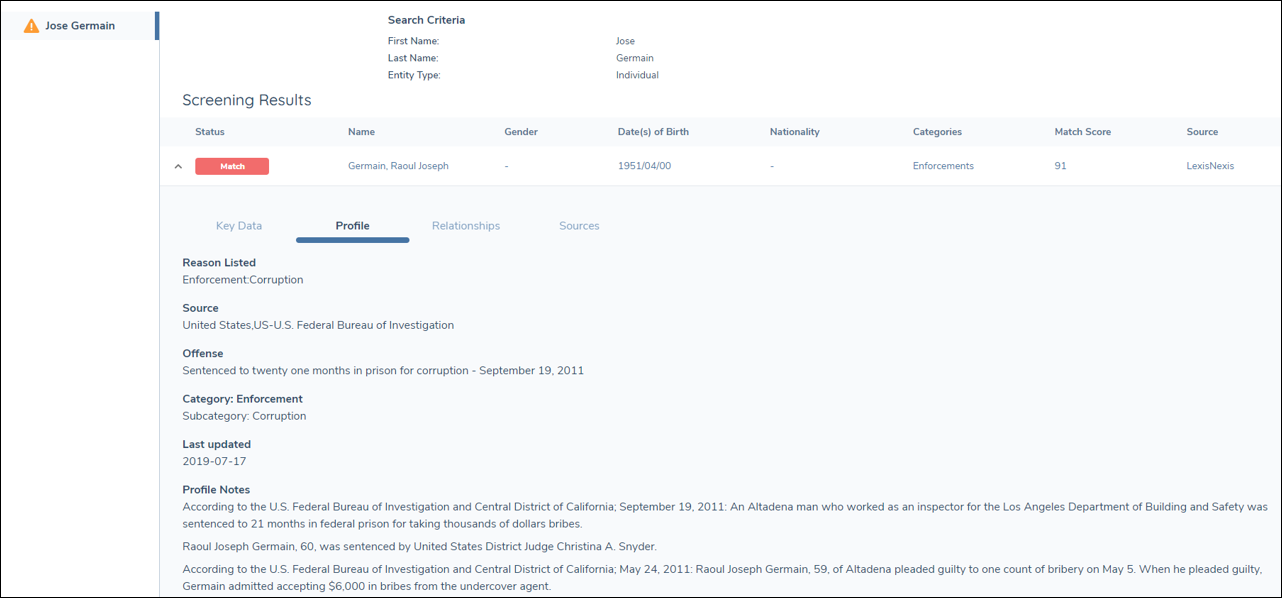
Client Materiality
The Client Materiality panel consists of a table of client entities for which a materiality determination must be made. An ongoing screening hit may be consumed for a single client entity, in which case you would simply see a single record here. However, an ongoing screening hit may also be consumed for an entity who is a related party of multiple clients. In this case, the Client Materiality panel allows the user to see all of the clients that are impacted by the ongoing screening hit, and the chain of ownership between those clients and the related party.
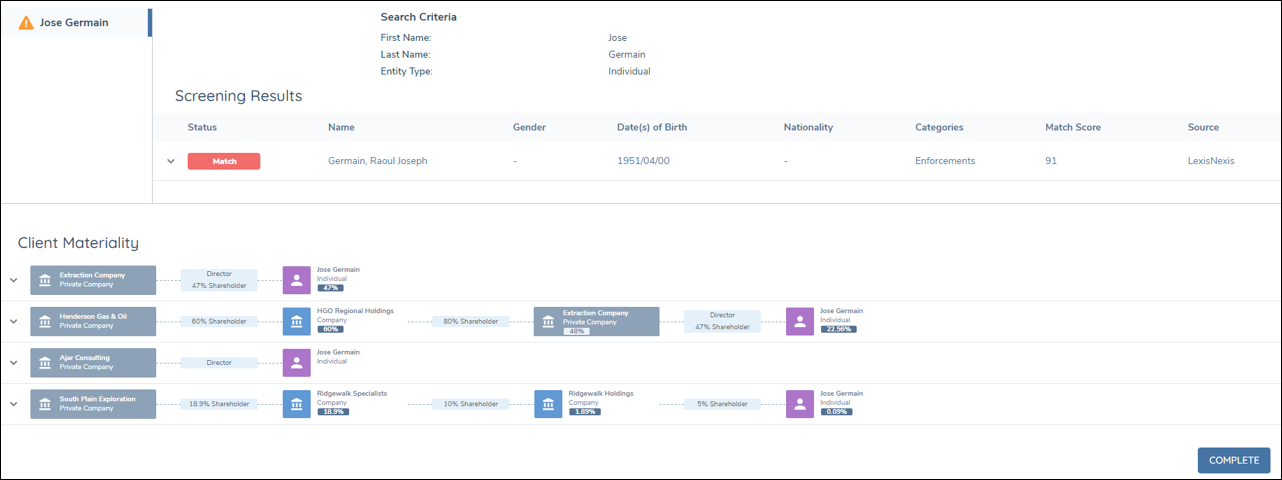
Each record in the panel can be expanded to allow the user to capture the outcome of the ongoing screening process in relation to each client. The fields that appear here are driven by the Policy configuration for the tenant.
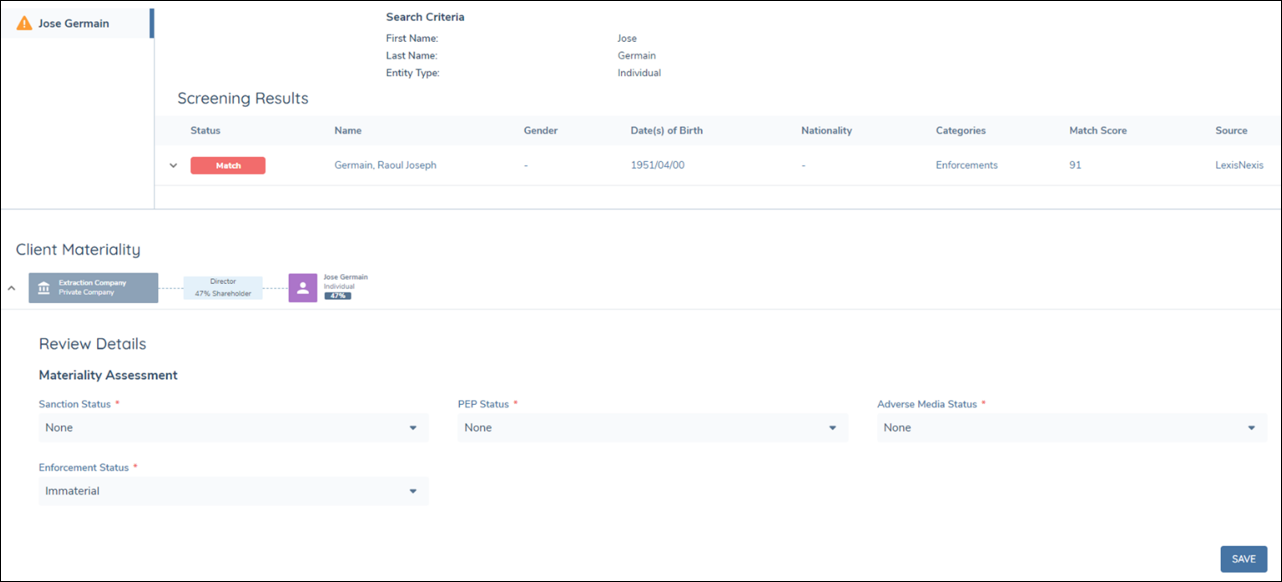
The default configuration consists of the following fields:
- PEP Status: The overall materiality of confirmed PEP hits in the context of the client entity.
- Sanctions Status: The overall materiality of confirmed Sanctions hits in the context of the client entity.
- Adverse Media Status: The overall materiality of confirmed Adverse Media hits in the context of the client entity.
- Enforcement Status: The overall materiality of confirmed Enforcement hits in the context of the client entity.
The user can select from the following options:
- Material: The confirmed screening hits in this category have a material impact on the client.
- Immaterial: The confirmed screening hits in this category do not have a material impact on the client.
- None: There are no confirmed screening hits in this category.
Materiality Aggregation Logic
When a user is making a determination of materiality in the Ongoing Screening task, they are making it only in the context of a particular relationship, but not taking into account previous screening results that may also impact the overall materiality status for the client. In the below example, the user may have determined that the Enforcements hit that has been triggered is Immaterial to the client being reviewed (Extraction Company), but the client may have previous confirmed Enforcements hits that should be considered in arriving at the overall status for Extraction Company. As a result, the system must perform an aggregation of the materiality statuses for the clients that are impacted by the Ongoing Screening hit. This ensures that a user does not have to manually review the entire history for the client before making a determination.
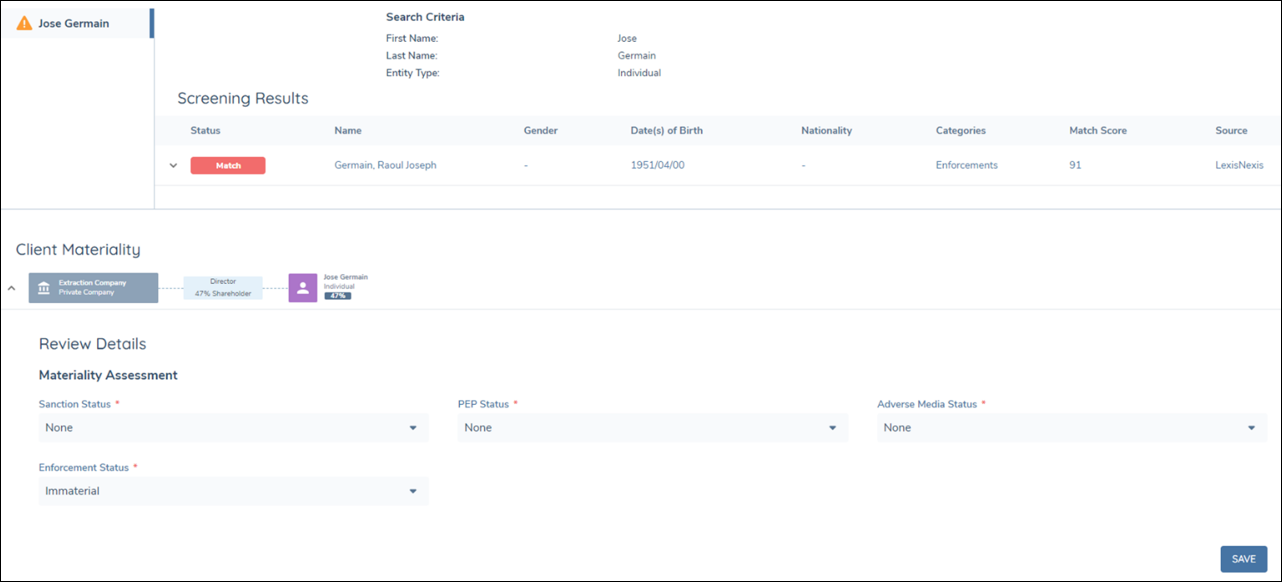
When the user saves the Materiality Assessment values, the system will check the previous values for the entity and take the maximum overall value which is saved to Entity Data. In the above example:
- If Extraction Company has a previous Enforcement Status of None, and the user selects Immaterial, the new Enforcement Status will be Immaterial.
- If Extraction Company has a previous Enforcement Status of Immaterial, and the user selects Material, the new Enforcement Status will be Material.
- If Extraction Company has a previous Enforcement Status of Material, and the user selects Immaterial, the new Enforcement Status will remain Material.
Journey Task: Related Client Launchpad
The Related Client Launchpad is similar to other Journey Launchpad tasks, and is used to automatically trigger associated journeys. The Related Client Launchpad task will trigger journeys for all impacted related clients that have been identified in the Client Materiality section described above. The associated journey that is launched will be based on the specific client configuration, but is generally used to capture the impact of the Ongoing Screening hit and re-calculate the Risk Rating for each of the related Clients.
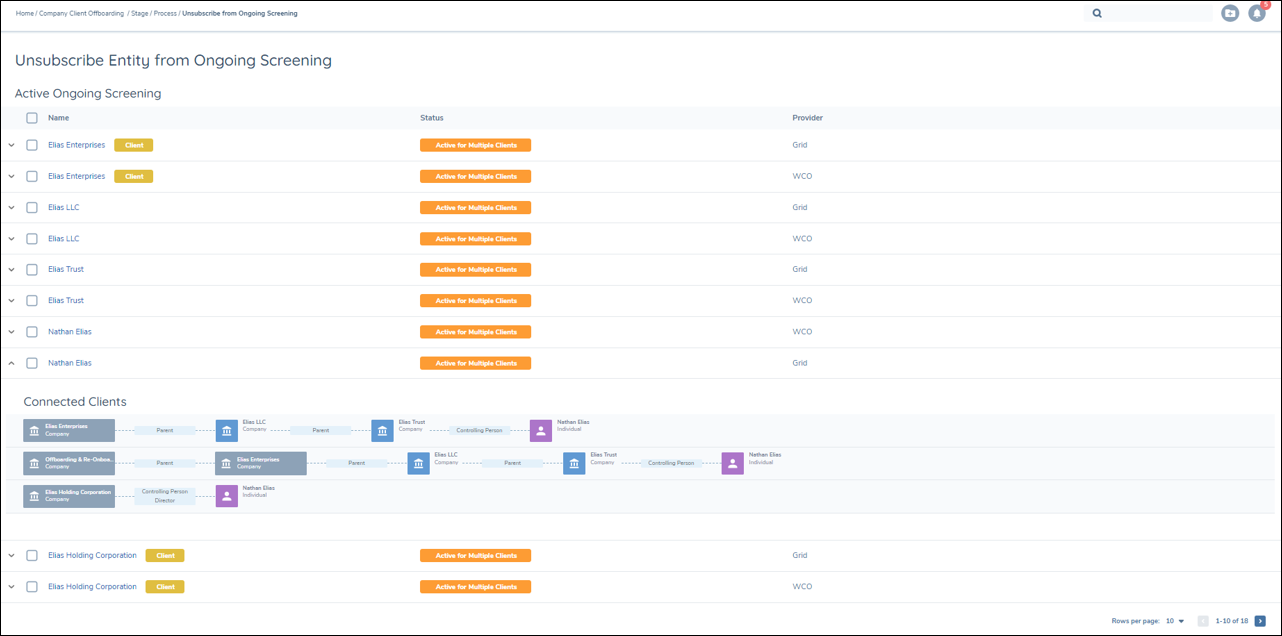
Journey Task: Unsubscribe from Ongoing Screening
The Unsubscribe from Ongoing Screening task is designed to allow a user to unsubscribe entities from the ongoing screening they are enrolled in. Similar to the Client Materiality panel, the Unsubscribe from Ongoing Screening task allows the user to see all of the clients and non-client related parties that are enrolled in ongoing screening and allows the user to view the way in which the entities are connected.
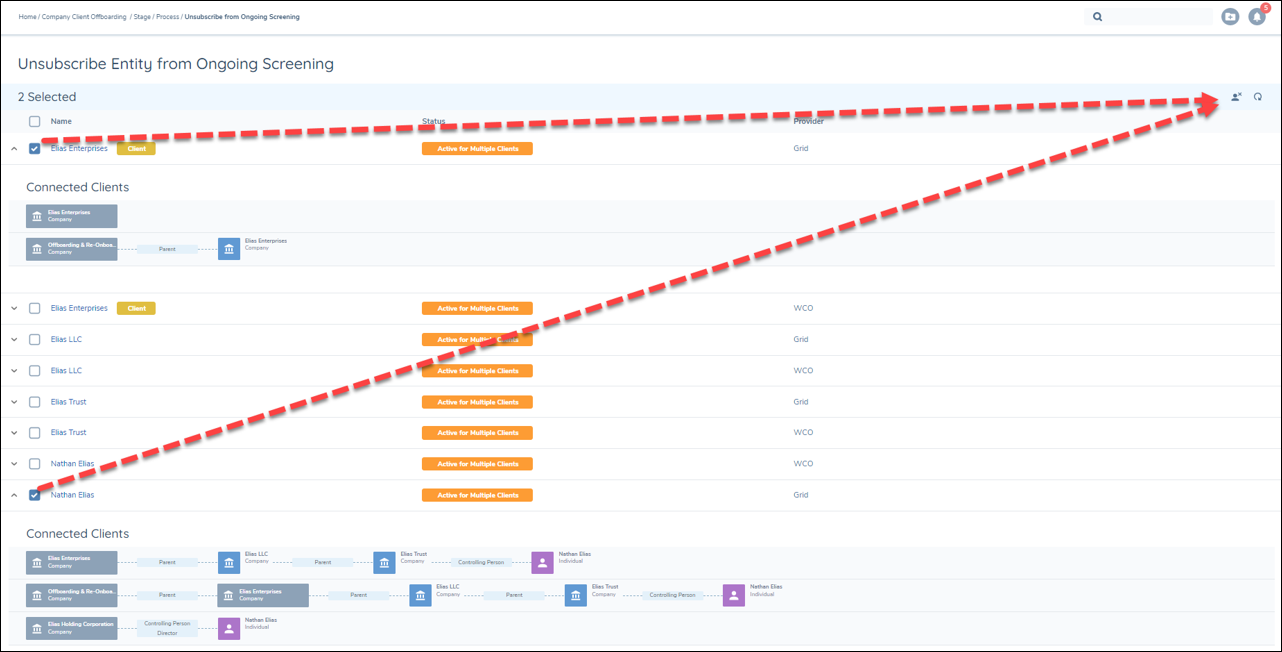
From the Unsubscribe from Ongoing Screening task, the user can unsubscribe the customer or the entities connected to it from ongoing screening by provider by selecting the entity and pressing the "Mark for unsubscribe" icon.
When this action is taken, the entities will be updated in the UI with a status chip of "To be Unsubscribed".
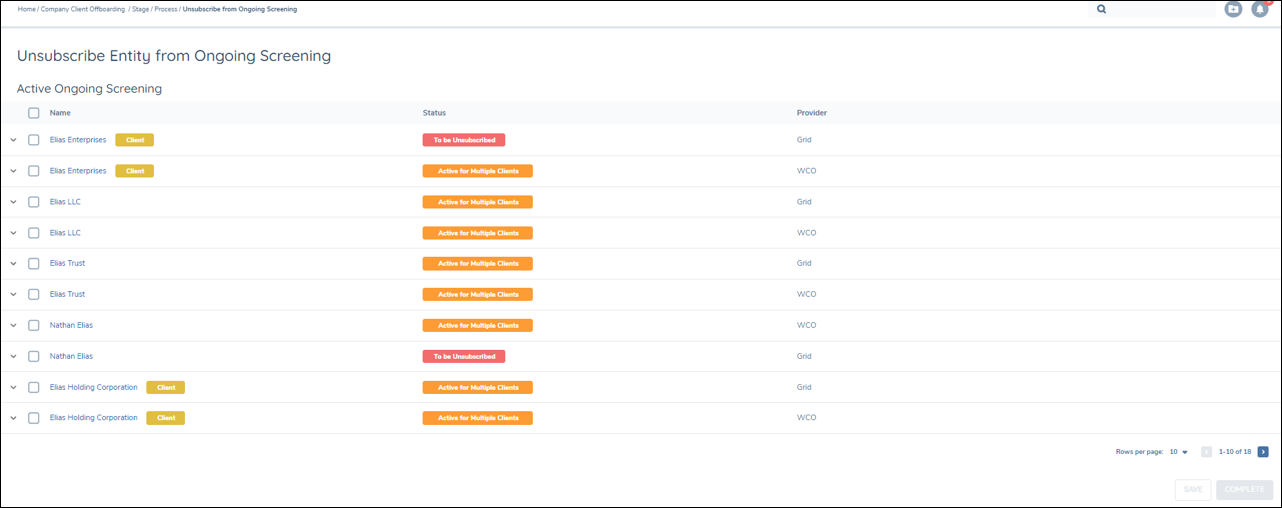
This can be reverted back by selecting the record and pressing the "Reset" button.

After the user is finished marking entities to be unsubscribed in the UI, the user can press either the "Save" button to commit their changes assuming they want to step away from the task and revisit it at a later date, or the user can press the "Complete" button to save their changes and complete the task.
When either of these buttons is selected and one or more of the entities selected to be unsubscribed is a customer or is associated to a customer that may not be part of the primary customer's hierarchy, then the user will be presented with a warning modal to confirm that entity should be unsubscribed.
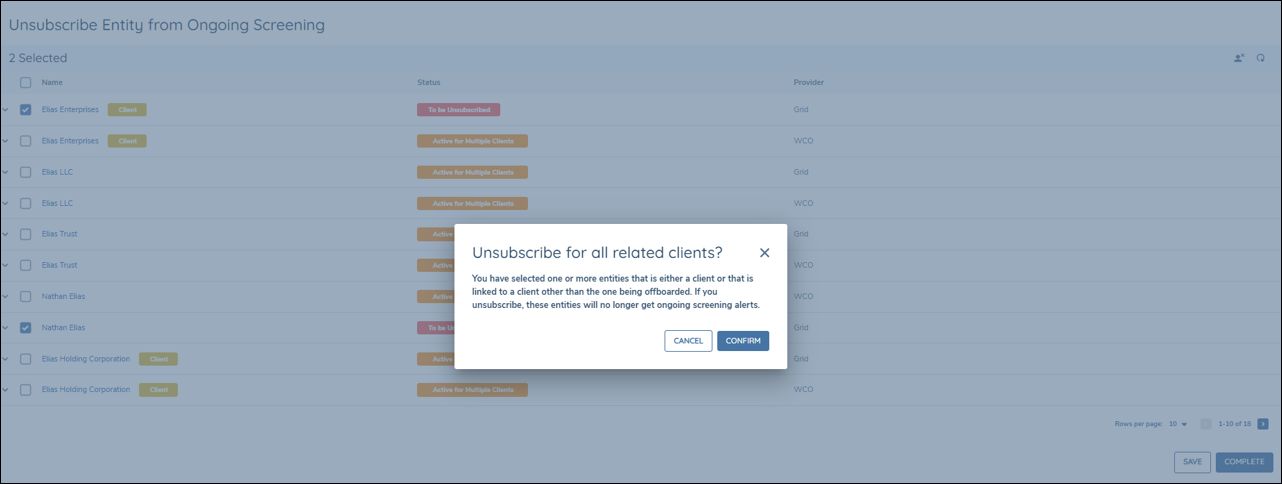
When the journey is completed, at the "Complete Client Offboarding" or "Verify Entity" task, the entity will become unsubscribed for the selected screening providers and the entity will show in the completed Unsubscribe from Ongoing Screening with a chip of "Unsubscribed".

Note: Whenever an entity that was unsubscribed for screening is subjected to future screening, it will be eligible to be re-enrolled into ongoing screening.
Configuring Ongoing Monitoring Data and Screening
Ongoing Monitoring Journey Configuration
Event Triggers
When configuring a journey in Journey Builder, the Event Triggers tab allows a user to specify conditions under which the journey should be triggered. For Ongoing Data Monitoring, this should be set to External Data.
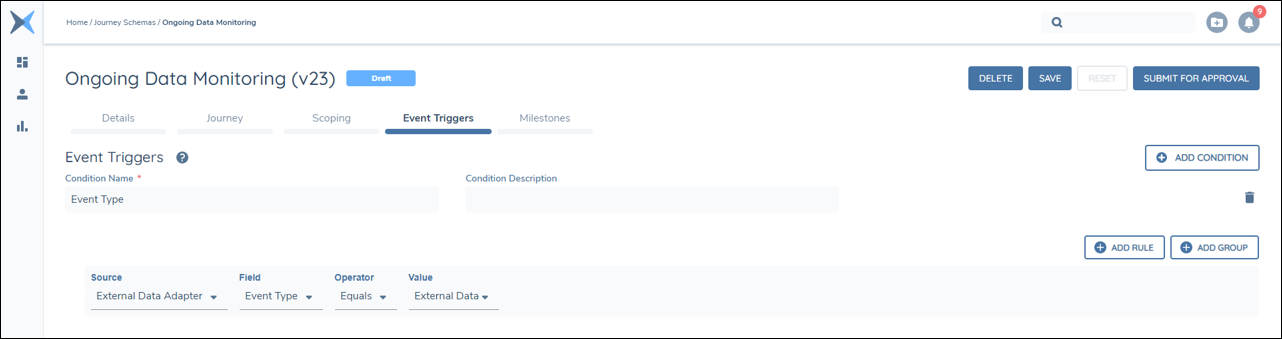
When this condition is set, that journey will be automatically triggered in response to an Ongoing Monitoring event from an External Data provider.
Materiality
Materiality can be applied to an Ongoing Monitoring journey by allowing configuration of conditional Stages/Processes/Tasks based on whether a particular attribute has changed within the journey. This is supported through the introduction of a new Source field in the Scoping Conditions Logic Engine. The Current Entity Changes source evaluates whether a particular Entity Data attribute has changed by comparing the current draft value at the point of evaluation to the verified value at the point the journey was triggered. If the condition is met, the conditional Stage/Process/Task will be triggered.
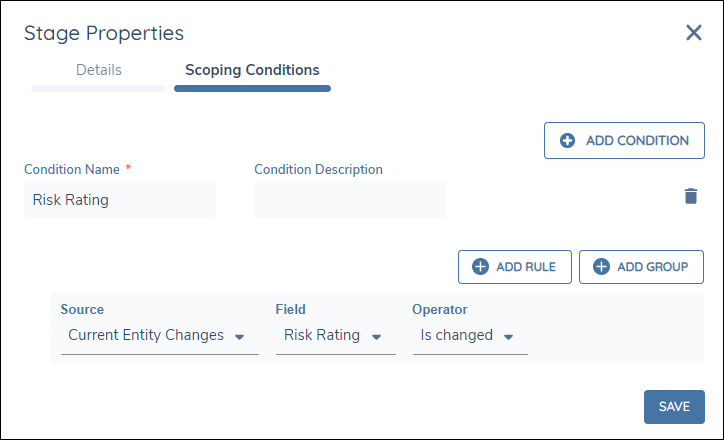
Sample Configuration
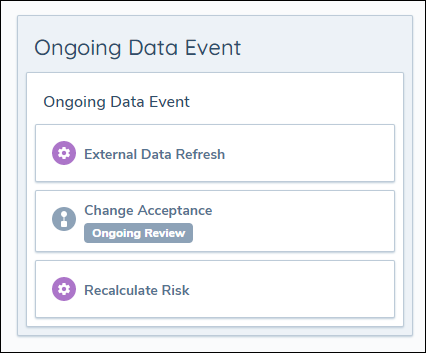
The Ongoing Data Monitoring journey is configurable to meet a client’s particular business process. However, it’s recommended that the first stage of the journey is captured as per the following Ongoing Data Event stage (Stage/Task Names can be renamed as required). Subsequent Stages of the journey can be configured to be triggered conditionally based on the materiality of the change that has occurred.
Sample Configuration for Materiality Aggregation Logic
The aggregation logic uses Lookup Metadata to determine the order of values when performing the aggregation. An Order column must be saved against the values in the Materiality Status lookup in order to avail of this.
- In the Reference Data Editor create a lookup called ‘Materiality Status’.
- Create the values that you wish to capture in this lookup.
- Add an additional column of Type = Number and call it ‘Order’.
- Rank the lookup values in order from Highest to Lowest (where Highest = 1).
- Link this lookup to the fields that are captured in the Materiality Assessment task.